Between the Whistles: How Elite Canadian Hockey Programs Are Winning the 72-Hour Recovery Battle
There is a quiet competition happening in Canadian hockey that never appears on a scoreboard. It takes place in hotel corridors, film rooms, weight facilities, and recovery suites. It unfolds in the hours immediately following the final buzzer and stretches through the next two to three days before the next puck drops. This is the 72-hour window—and for the development programs that understand its value, it has become one of the most powerful tools in building championship-calibre athletes.
For too long, the culture surrounding minor and junior hockey in Canada treated the time between games as a passive interval. Players rested, families regrouped, and coaches perhaps reviewed a few notes. The assumption was straightforward: the game itself was the development vehicle. Everything else was secondary.
That assumption is no longer acceptable at the elite level.
The Science Behind the Window
Sports science has made clear what high-performance coaches have long suspected: the physiological and psychological processes that follow intense competition are not incidental—they are foundational. In the 24 hours immediately after a game, the body is engaged in a complex repair cycle. Muscle tissue is rebuilding. The nervous system is recalibrating. Cortisol levels, elevated during competition, are gradually normalising.
If this phase is mismanaged—through poor sleep, inadequate nutrition, or excessive physical load—athletes do not simply fail to improve. They regress. Chronic mismanagement of post-game recovery is one of the primary contributors to the mid-season performance plateaus that frustrate so many development-age players across Canada.
Conversely, when this window is structured with intention, it accelerates adaptation. The athlete who sleeps well, refuels intelligently, and engages in low-intensity movement in the 24 hours post-game is physiologically primed to absorb the next round of skill development at a higher rate than one who has not.
Elite Canadian academies are building entire programme frameworks around this understanding.
Day One: Recovery as a Discipline
In the most sophisticated hockey development environments operating across Ontario, Alberta, Québec, and British Columbia, Day One of the inter-game window is treated with the same professional rigour as a practice session. It is not optional. It is not informal. It is structured.
Active recovery—light skating, mobility work, pool sessions where available, or guided stretching routines—is scheduled and supervised. Nutritional protocols are communicated clearly, with an emphasis on carbohydrate replenishment and protein intake timed to support muscle repair. Sleep hygiene, often undervalued in youth sport, is addressed directly through education delivered to both players and their families.
Some programmes have introduced wearable monitoring technology that tracks heart rate variability and sleep quality overnight, giving coaching staff objective data on each athlete's readiness state entering Day Two. This is no longer the exclusive domain of NHL organisations. Forward-thinking development academies are bringing these tools into the under-16 and under-18 environment, establishing habits and literacy around self-monitoring that will serve athletes throughout their careers.
Day Two: The Skill Refinement Zone
If Day One belongs to the body, Day Two belongs to the craft. This is where elite programmes distinguish themselves most sharply from their peers.
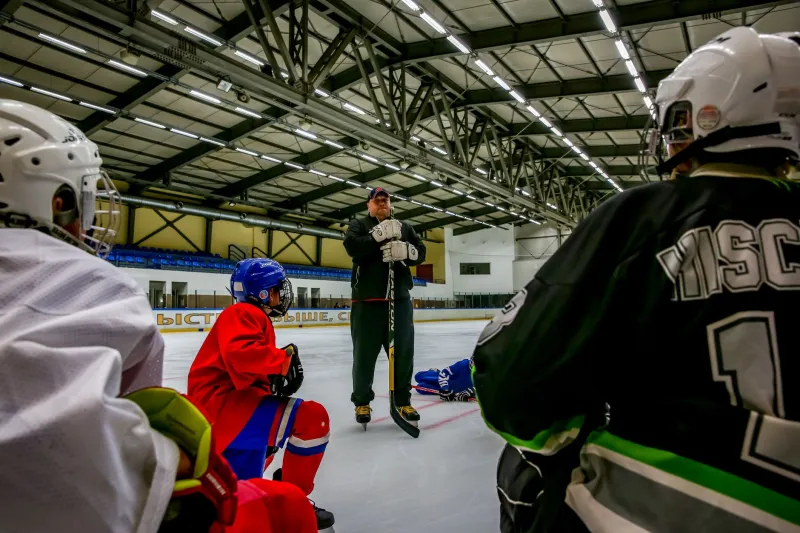
With physiological recovery largely completed, athletes in top Canadian academies enter what many coaching staffs refer to as the refinement window. On-ice sessions during this phase are deliberately structured around technical precision rather than competitive intensity. The practice environment is controlled, the feedback is immediate, and the objectives are highly specific—drawn directly from the performance data gathered during the preceding game.
This is where video analysis earns its place in the development process. Coaches who have catalogued key moments from game footage—positioning errors, missed reads, technical breakdowns in skating mechanics—bring those clips into purposeful conversation with their athletes. The goal is not criticism. The goal is pattern recognition. Players who can identify their own tendencies under pressure, and who have practised deliberate corrections in a lower-stakes environment, are far better equipped to self-regulate during the next competition.
The concept of deliberate practice, well established in performance psychology literature, is at the heart of this approach. Repetition without reflection produces habit. Repetition with reflection produces mastery. The 72-hour window, structured correctly, is where reflection becomes rehearsal.
Day Three: Mental Preparation and Competitive Readiness
The final phase of the inter-game window is perhaps the most overlooked at the development level, and yet it is the one that separates athletes who perform under pressure from those who merely perform under ideal conditions.
Leading Canadian hockey academies are integrating sport psychology practices into Day Three preparation. Visualisation routines, pre-competition mental activation protocols, and team cohesion activities are scheduled alongside physical preparation. Coaches facilitate brief but meaningful conversations around competitive mindset—reviewing the team's identity, reinforcing process-based goals, and ensuring that athletes enter the next game with clarity of purpose rather than anxiety about outcome.
This is not abstract work. It is practical, repeatable, and measurable over time. Programmes that invest in mental preparation consistently report not only improved performance in high-pressure moments but also greater resilience following losses—a quality that is essential for any athlete aspiring to move through the ranks of Canadian hockey's highly competitive development pathway.
What This Means for Families and Programme Selection
For parents navigating the increasingly complex landscape of hockey academies and development programmes in Canada, the 72-hour window offers a useful evaluative lens.
The right questions are not simply about ice time or league affiliation. They are about programme philosophy between games. How does the staff approach recovery? Is there a nutrition framework in place? Are players receiving individual feedback derived from game footage? Is mental preparation part of the competitive cycle, or is it treated as an afterthought?
A programme that can answer these questions with specificity and conviction is one that has thought carefully about development as a comprehensive, continuous process—not a series of isolated game-day events.
The Compounding Effect
Here is the reality that every serious hockey family and coaching professional must internalise: marginal gains compound. The athlete who manages the 72-hour window well over the course of a full season is not simply a little better rested than their peers. They have accumulated dozens of additional high-quality development cycles. They have refined their technique under conditions designed for retention. They have built mental habits that hold under pressure.
Over a season, that accumulation is significant. Over a career, it is transformative.
The game is decided between the whistles as much as during them. The programmes that understand this are not waiting for game day to develop their athletes. They are developing them every hour in between—and that is precisely how champions are forged.